Building Creative Confidence in Kids: Why the Process Matters More Than the Product

Free PopSmart Open House: Science Olympiad and National Science Bowl! Click here!

What we're talking about!
Check back often for updates!
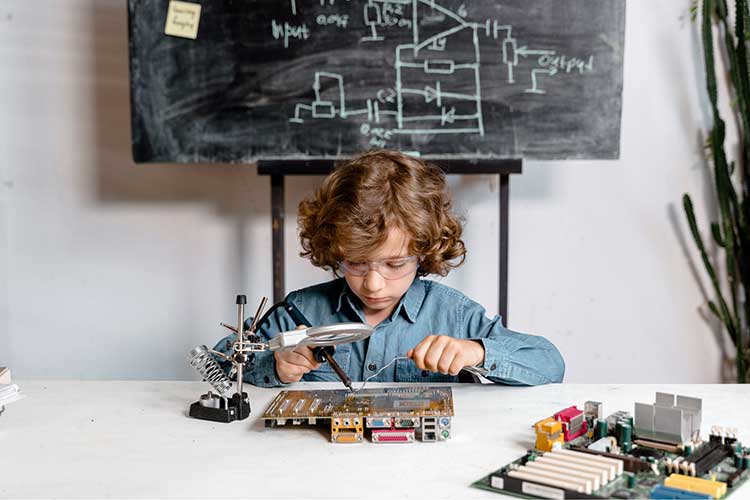
How shifting our focus from what children make to how they make it
can unlock a lifetime of creative courage.
Picture a five-year-old at a table with paint, paper, and complete freedom. She does not hesitate. She picks up the brush, drags it across the page in big sweeping arcs, mixes the colours until they turn brown, and declares the result “the best thing I’ve ever made.”
Now picture a ten-year-old handed the same materials. She pauses. She looks at the blank page for a long time. She asks: “What am I supposed to make?” And when she finally draws something, she tilts it away so no one else can see.
What happened in between? Somewhere along the way, the five-year-old’s fearless joy got replaced by self-consciousness, comparison, and the quiet belief that creativity is something you either have or you don’t. Psychologists have a name for what she lost: creative confidence.
At Popsmart Academy, we believe creative confidence is not a personality trait. It is a skill, one that can be grown, protected, and taught. And this May, we want to talk about how.
The term was popularized by IDEO founder David Kelley and his brother Tom Kelley in their research on design thinking. They define creative confidence as “the natural ability to come up with new ideas and the courage to try them out.” It is not about artistic talent. It is about the belief that your ideas are worth expressing and the willingness to try, even when the outcome is uncertain.
Research in developmental psychology supports this. Studies by Carol Dweck at Stanford show that children who believe their abilities are fixed, that they are either “creative” or they are not, are far more likely to give up when they hit a wall. Children who see creativity as something that grows with practice are more persistent, more willing to take risks, and ultimately more innovative.
The good news: the shift from fixed to growth thinking begins at home, long before school.
Most parents respond to a child’s drawing, story, or painting with instinctive praise: “That’s amazing! You’re so talented!” It feels kind. It feels encouraging. But research suggests it can quietly undermine creative confidence.
When we praise the outcome, the finished painting, the completed story, we accidentally teach children that the goal of creating is to produce something impressive. The next time they pick up a pencil, they are no longer asking “what do I want to make?” They are asking “will this be good enough?” That single shift is enough to silence a young creative voice.
I am not saying that you need to stop showing appreciation. Instead try “process praise”, it works differently. Instead of commenting on the result, you comment on the effort, the choices, and the thinking behind it.
Instead of: “Wow, that’s so pretty!”
Try: “I love how you decided to mix those two colours. What made you choose that?”
Instead of: “You’re such a great writer!”
Try: “I noticed you changed your ending — what made you decide to do that?”
Instead of: “That looks just like a real dog!”
Try: “Tell me about your drawing. What were you thinking about when you made it?”
One of the most powerful things we can do for a young creative is to normalize imperfection, not by dismissing it, but by celebrating what it teaches.
When children see mistakes as information rather than failure, something shifts. They become more willing to experiment. They stop guarding their work and start playing with it. And play, developmental psychologists consistently find, is where the deepest learning happens.
Here are a few simple ways to build this culture at home:
One of the most common misconceptions about creative confidence is that it belongs only to children who love to draw, paint, or write stories. In reality, creativity is a cognitive mode, a way of approaching problems with curiosity, flexibility, and a willingness to try more than one solution.
The child who builds an elaborate railway system out of blocks is being creative. So is the child who invents a new set of rules for a playground game, or who figures out how to stack objects in a way that defies expectations, or who asks “why does this have to work that way?” Creative confidence shows up in mathematics, science, writing, social situations, and everyday problem-solving.
At Popsmart Academy, we see this every day. Children who feel safe to express their thinking — whose ideas are received with curiosity rather than correction — are bolder across every subject. They ask better questions. They try harder things. They recover from setbacks faster. Creative confidence, it turns out, is not just a nice trait to have. It is a foundation for learning itself.
You do not need an art studio, a music room, or a special curriculum. Creative confidence grows in small, everyday moments. Here are five ways to start:
The five-year-old with the paint and the fearless brush, she is still in every child. Our job is simply to make sure she stays.
Happy creating from all of us at Popsmart Academy.
popsmartacademy.com | May 2026 | Creative Confidence Series
Ready to empower your child’s critical thinking? Explore our different programs and discover how PopSmart Academy can help your child reach their full potential. Book a FREE trial class here.

Help your kids fall in love with reading!
Need a list of amazing books to get your kids inspired about writing their own stories?
Grab your free copy by completing the form.
We'll email you the ebook!