A Place of Free Play

Free PopSmart Open House: Science Olympiad and National Science Bowl! Click here!

What we're talking about!
Check back often for updates!
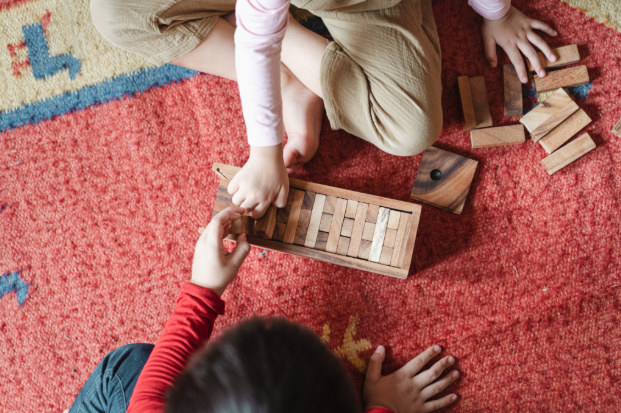
As a teacher and former child, I think it’s particularly fortunate that PopSmart Academy is so close to Pine Lake Park. It reminds me of the opportunities I had in my childhood.
When I was five years old, I played with my neighbor and best friend, Brianna, in our little neighborhood at a dead end enclosed by woods. When the sun was high in the sky and butterflies and bees visited throughout the summer day, we’d be singing on the swingset in Brianna’s yard or catching grasshoppers in mine. We’d be exploring—going to our neighbors to spend time with their cats and dogs, donning costumes for some roleplaying, and acting out adventures with our toys and figurines.
It wasn’t all fun and giggles. There were times we argued about how a game should be played, a plot point in a story, or what to do with the little time we had left before dinner. But we didn’t want to stay mad or upset. We wanted to have fun.
Because to the brain, having fun primes one for adulthood.
The practice of this free play, where we choose our own activities1,2, molded our unstructured time like clay in our hands. It is a right for every child, recognized and advocated by the United Nations High Commission for Human Rights3. It’s not just a block of time for the child to do whatever they want; it’s a time for their brain to develop4,5.
By choosing our own activities and solving our conflicts in the pursuit of fun, we developed the fundamental skills of self-regulation, creativity, persuasion and negotiation4,5,6. We learned to cope with being disappointed, frustrated, afraid, excited, and hurt. Overall, we learned resilience.
Jeffrey Burgdorf is a research associate professor at the Northwestern University
Feinberg School of Medicine who studies neuroscience and gene expression related to free play. Affiliated with the National Institute of Play, he advocates for the practice and has found connections between a healthy mind and play7.
“The science of how the brain, happiness and joy works is really linked around play,” said Burgdorf. “It’s actually where our brains are at our best. You’re the most creative, social, insightful, empathetic when you’re playing, and you have the best ability to take in new ideas and to remember things and to think critically.”
To explain the phenomenon, he pictured play as a dial, the intensity of its effects increasing with the more a child engages in their fun. These effects are seen when studying a child’s brain waves during the activity, particularly in the alpha waves.
Brain waves are created by looping rhythmic, synchronized electrical activity in the brain between excitatory and inhibitory neurons across different regions8. The frequencies of these electrical patterns influence mental states such as rest, focus, attention, or creativity. Alpha waves are generated through electrical communication loops between the thalamus, the brain's sensory hub, and the cerebral cortex, responsible for human consciousness and decision-making9,10.
During play, these alpha waves intensify and are accompanied by a positive emotion:
happiness. When more people engage in play together, the more their brain waves synchronize7, creating an air of happiness like the kind Brianna and I got to share on so many occasions13,14. Play’s role in the amplification of alpha brain waves, which are critical for memory recollection, makes it an important factor in how children learn and remember4,5,8,11.
Play is not limited to outdoor activities. Whether the activity is a sport, a recreational club, or a small game, it’s the choice of the child to participate in them and be part of this activity that brings the benefits2,7.
I hadn’t known at the time, but my mother and Brianna’s mother were watching us from the shadows, monitoring our safety and reporting to each other through the telephone. They knew exactly what we were doing, while we were blissfully unaware of their watchful eyes. We were in our own world, and they were the secret spectators.
At PopSmart Academy, we, the teachers, continue to be the spectators to the kids’ play and education, ensuring their safety while they build on their executive functioning skills and learn resilience through free play.
Our goal is to make sure the children can live and learn well. Their goal is to have fun. Together, we make irreplaceable memories.
Citations:
1. “The Basics - National Institute for Play.” National Institute for Play, 2025, nifplay.org/what-is-play/the-basics/.
2. “What Is Free Play and Why Should You Encourage It at Home?” Unicef.org, 2020, www.unicef.org/parenting/child-care/what-is-free-play.
3. “Convention on the Rights of the Child.” OHCHR, 2025, www.ohchr.org/en/instruments-mechanisms/instruments/convention-rights-child.
4. Yogman, Michael, et al. “The Power of Play: A Pediatric Role in Enhancing Development in Young Children.” Pediatrics, vol. 142, no. 3, American Academy of Pediatrics (AAP), Sept. 2018, https://doi.org/10.1542/peds.2018-2058.
5. Barker, Jane E., et al. “Less-Structured Time in Children’s Daily Lives Predicts Self-Directed Executive Functioning.” Frontiers in Psychology, vol. 5, Frontiers Media, June 2014, pp. 593–93, https://doi.org/10.3389/fpsyg.2014.00593.
6. “What Is Executive Function? How Executive Functioning Skills Affect Early Development.” Center on the Developing Child at Harvard University, 12 Dec. 2024, developingchild.harvard.edu/resources/infographics/what-is-executive-function-and-how-does-it -relate-to-child-development/.
7. Burgdorf, Jeffrey, PhD. Personal interview. 13 Nov. 2025. https://www.linkedin.com/in/jeffrey-burgdorf-aba8a470/
8. Wolfgang Klimesch. “Alpha-Band Oscillations, Attention, and Controlled Access to Stored Information.” Trends in Cognitive Sciences, vol. 16, no. 12, Elsevier BV, Nov. 2012, pp. 606–17, https://doi.org/10.1016/j.tics.2012.10.007.
9. Hughes, Stuart W., and Vincenzo Crunelli. “Thalamic Mechanisms of EEG Alpha Rhythms and Their Pathological Implications.” The Neuroscientist, vol. 11, no. 4, SAGE Publishing, Aug. 2005, pp. 357–72, https://doi.org/10.1177/1073858405277450.
10. Llinás, Rodolfo R., and Mircea Steriade. “Bursting of Thalamic Neurons and States of Vigilance.” Journal of Neurophysiology, vol. 95, no. 6, American Physiological Society, Mar. 2006, pp. 3297–308, https://doi.org/10.1152/jn.00166.2006.
11. Hsueh, Jen-Jui, et al. “Neurofeedback Training of EEG Alpha Rhythm Enhances Episodic and Working Memory.” Human Brain Mapping, vol. 37, no. 7, Wiley, Apr. 2016, pp. 2662–75, https://doi.org/10.1002/hbm.23201.
12. Fu, Lei, et al. “Everyday Creativity Is Associated with Increased Frontal Electroencephalography Alpha Activity during Creative Ideation.” Neuroscience, vol. 503, Elsevier BV, Sept. 2022, pp. 107–17, https://doi.org/10.1016/j.neuroscience.2022.09.005.
13. Zhao Q, Zhao W, Lu C, Du H, Chi P. Interpersonal neural synchronization during social interactions in close relationships: A systematic review and meta-analysis of fNIRS hyperscanning studies. Neurosci Biobehav Rev. 2024 Mar;158:105565. doi: 10.1016/j.neubiorev.2024.105565. Epub 2024 Jan 29. PMID: 38295965.
14. Chen IC, Hsu HC, Chen CL, Chang MH, Wei CS, Chuang CH. Interbrain synchrony attenuation during a peer cooperative task in young children with autistic traits -an EEG hyperscanning study. Neuroimage. 2025 May 15;312:121217. doi: 10.1016/j.neuroimage.2025.121217. Epub 2025 Apr 15. PMID: 40246257.

Help your kids fall in love with reading!
Need a list of amazing books to get your kids inspired about writing their own stories?
Grab your free copy by completing the form.
We'll email you the ebook!