Writing as Play: How Journaling This Summer Can Transform Your Child's Thinking

Win Prizes at our Future Leaders Debate Championship! Click here!

What we're talking about!
Check back often for updates!
A simple notebook. A few minutes a day. And a surprisingly powerful impact
on how your child thinks, feels, and communicates.
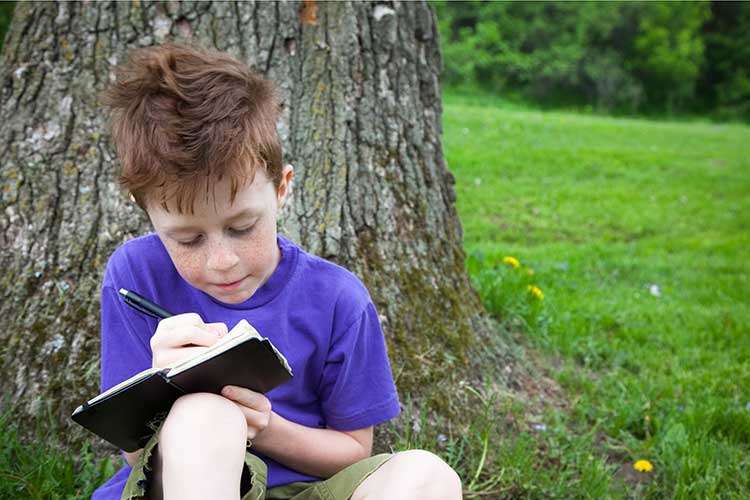
Ask most children what they want to do this summer and journaling is unlikely to make the list. It sounds like homework. It sounds like a chore. It sounds suspiciously like something adults think is good for you.
Yet give a child an interesting prompt, a notebook they actually chose, and the freedom to write without being graded and something remarkable tends to happen. They don’t want to stop.
Reflective writing, it turns out, is one of the most quietly powerful things a young person can do. Research on cognitive development and reflective writing consistently shows that the act of putting thoughts into words, regularly, freely, and without pressure, has long term results. It builds vocabulary, sharpens emotional intelligence, strengthens narrative thinking, and deepens self-awareness in ways that few other activities can match.
The best part? When it’s done right, children don’t experience it as learning at all. They experience it as play.
The science on reflective writing and child development is both robust and genuinely exciting for parents to know about.
Writing Builds the Brain
Psychologist James Pennebaker spent decades studying the effects of expressive writing on the brain. His research found that translating experiences into language, especially emotionally charged ones, activates the prefrontal cortex. It is the region responsible for reasoning, decision-making, and impulse control. When children write about their day, their feelings, or something that confused them, they are not just recording events. They are processing them, organizing them, and making sense of the world through words.
Vocabulary Grows Through Use, Not Memorization
One of the most consistent findings in language acquisition research is that children expand their vocabulary most effectively when they encounter and use words in context, not through flashcard drills. Journaling creates exactly that context. A child who is trying to describe the way the sky looked at sunset, or explain why they felt uncomfortable at a party, is reaching for words they do not yet have. That reaching and that stretch is where vocabulary genuinely grows.
Narrative Thinking Is a Foundational Skill
Developmental psychologist Dan McAdams describes narrative identity as the ability to understand your own life as a story with a beginning, middle, and ongoing future. It is one of the core tasks of healthy psychological development. Children who practice telling their own stories, even in small ways, develop stronger cause-and-effect reasoning, more sophisticated empathy, and a more stable sense of self. Journaling is narrative thinking made daily.
Emotional Intelligence Is a Muscle
Research from Yale’s Centre for Emotional Intelligence shows that the ability to identify, name, and regulate emotions is not fixed at birth, rather it is a skill that develops with practice. Writing about feelings, even briefly, even imperfectly, gives children regular practice in emotional labelling, which is the first and most foundational step in emotional regulation. A child who can write “I felt left out today and I don’t really know why” is a child who is developing the emotional vocabulary to eventually navigate that feeling with more agency and less distress.
"Children who write about their experiences don’t just remember them better. They understand them better."
Here is where most well-intentioned journaling attempts fall apart. A parent buys a beautiful notebook, sets a daily writing time, and within a week the child is sighing dramatically and writing the minimum number of sentences required to be released from the table.
The research on intrinsic motivation is unambiguous: when writing feels like a task being done for someone else, the cognitive and emotional benefits shrink significantly. When it feels like an expression of the child’s own inner life, the benefits multiply.
The difference, practically speaking, comes down to three things: choice, prompts, and zero grades.
Let Them Choose the Notebook
This sounds trivial. It is not. A child who picks their own notebook, the one with the galaxy cover, or the tiny one that fits in a pocket, or the plain sketchbook they can draw in as well as write, has already claimed ownership of the practice. That ownership matters enormously to how they show up to the blank page.
Use Prompts That Spark Genuine Curiosity
Open-ended prompts that invite imagination, opinion, and reflection produce far richer writing than “write about your day.” A child staring at “write about your day” will produce three sentences. A child staring at “what is something you believe that most people around you don’t?” might write for twenty minutes without looking up.
More on specific prompts below.
Never Grade It. Never Correct It.
This is the most important rule and the hardest one for adults who care about spelling. Resist. A summer journal is not a writing assignment. The moment a child feels their journal will be evaluated, the psychological safety required for honest reflection evaporates. Spelling, grammar, punctuation, none of it matters here. What matters is that the child feels the page is entirely theirs.
Keep these somewhere accessible, on the fridge, in the notebook itself, or read one aloud each morning and let your child choose whether to use it or ignore it entirely. The best prompt is the one that makes them pick up the pen.
For the Curious Mind
For the Feeling Things
For the Storyteller
For the Big Thinker
For the Dreamer
The single biggest mistake parents make when introducing a journaling habit is making it feel significant. A formal announcement, a dedicated time slot, a set number of minutes required all of these signal to a child that this is a ‘Thing They Have to Do’. Children are extraordinarily good at resisting ‘Things They Have to Do’.
Instead, try this:
There is something quietly radical about handing a child a blank page and saying: this is yours. Fill it however you want. No one will mark it. No one will judge it. It is just for you.
In a world that asks children to perform constantly, to get the grade, pass the test, hit the benchmark, a summer journal is an act of intellectual freedom. It says: your inner life is worth paying attention to. Your questions matter. Your stories are worth telling.
That message, repeated daily across a summer, does something to a child that no curriculum can quite replicate. It builds a thinker who knows that thinking is valuable. A writer who knows that writing is for them. A person who knows that their inner world is rich, interesting, and worth exploring.
That is not a small thing. That is everything. Stay curious.
Looking for more ways to keep your child’s curiosity alive this summer? Explore PopSmart Academy’s summer camps and writing programs here.


Help your kids fall in love with reading!
Need a list of amazing books to get your kids inspired about writing their own stories?
Grab your free copy by completing the form.
We'll email you the ebook!