The Science of Failure: What Happens in the Brain When We Mess Up

Free PopSmart Open House: Science Olympiad and National Science Bowl! Click here!

What we're talking about!
Check back often for updates!
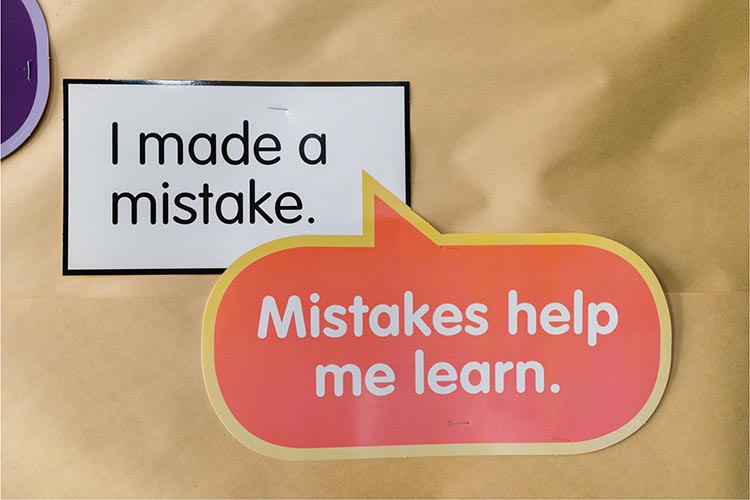
In the world of learning, failure often feels like a dead end. But science tells us a different story: failure is not the opposite of success—it's the foundation of it. In classrooms, labs, and even at home, our brains are constantly recalibrating, rewiring, and growing stronger every time we make a mistake. Understanding the neuroscience and psychology behind failure can change how we respond to setbacks, especially for students. Rather than seeing failure as something to avoid, we can learn to embrace it as a tool for growth.
When we mess up, our brains light up. Neuroscience research shows that making a mistake triggers increased brain activity in the anterior cingulate cortex (ACC), the part of the brain responsible for detecting errors and monitoring performance. This surge of activity signals the brain to pay attention: something didn’t go as expected, and it’s time to learn from it.
A landmark study from the University of Southern California found that participants who were more aware of their mistakes had stronger activation in the ACC and showed better performance on future tasks. In other words, when we recognize and reflect on our errors, our brains adapt and improve. This is especially important for students: creating space to notice and talk about mistakes helps them build metacognitive awareness—the ability to think about their own thinking.
Feedback is often where failure and learning intersect. The brain responds to feedback by activating reward pathways, especially when the feedback is constructive and timely. Dopamine—the brain’s "feel good" neurotransmitter—is released not just when we succeed, but also when we predict an outcome and are surprised by the result. That surprise, even if it's a failure, can lead to curiosity and deeper learning.
According to a study published in Nature Neuroscience, this feedback loop strengthens learning by reinforcing neural connections. The key takeaway: when feedback is framed as a guide rather than a judgment, students become more open to risk-taking and resilience.
The process of struggling through a challenge—often called productive failure—actually enhances learning more than getting the right answer immediately. Research by education expert Manu Kapur shows that students who first try to solve complex problems on their own, even unsuccessfully, learn more deeply when they eventually receive direct instruction.
Why does this happen? Struggle engages working memory, promotes cognitive flexibility, and forces the brain to search for patterns and solutions. This mental effort creates stronger, more durable learning. It's like lifting a heavier weight: it might be hard in the moment, but it's building long-term strength.
Of course, failure isn’t just a cognitive event—it’s an emotional one too. The brain's amygdala, which processes emotions like fear and anxiety, often lights up during failure. For students, this can mean that mistakes trigger self-doubt or avoidance. But when failure is normalized and de-stigmatized, the emotional impact changes. Students begin to associate failure with challenge rather than shame.
This is where classroom culture matters. Teachers and parents who model their own mistakes, celebrate effort, and offer encouragement help rewire the emotional response to failure. Over time, the brain can form positive associations with challenge, seeing it not as a threat but as an opportunity to grow.
Stanford psychologist Carol Dweck's work on growth mindset reinforces this science. Students who believe their abilities can improve through effort are more likely to persist through difficulty. Brain scans show that growth-minded individuals have more error-related activity in the ACC and greater activation in the prefrontal cortex, which supports goal-setting and problem-solving.
When students shift from "I'm not good at this" to "I'm not good at this yet," they reframe failure as part of the learning journey. That small shift in language reflects a big shift in brain behavior.
So how can we apply this science in real life? Here are a few strategies:
When we normalize failure as part of learning, we remove the stigma and increase engagement. We send a powerful message: your brain grows when you struggle. And when families and educators embrace that together, we raise learners who are not afraid to try, to ask, and to try again.
The science is clear: failure is not a flaw in the learning process—it is the learning process. Every time a student stumbles, the brain fires, adapts, and strengthens. Mistakes become data points. Struggle becomes scaffolding. And with the right support, feedback, and mindset, students can turn failure into one of their greatest assets.
At PopSmart Academy, we believe in celebrating mistakes as moments of growth. Because in every "oops" lies the potential for an "aha."
Let’s keep building brains—one glorious mistake at a time.
Ready to empower your child’s critical thinking? Explore our science programs and discover how PopSmart Academy can help your child reach their full potential. Book a FREE trial class here.

Help your kids fall in love with reading!
Need a list of amazing books to get your kids inspired about writing their own stories?
Grab your free copy by completing the form.
We'll email you the ebook!